
Most visitors to Genoa spend their time in the old town — the narrow caruggi, the cathedral, the Porto Antico — and leave without ever discovering what lies at the other end of the city's elegant seafront promenade. That would be Boccadasse, a small fishing village that has somehow survived intact inside one of Italy's largest port cities, and one of the most quietly beautiful spots on the entire Ligurian coast.
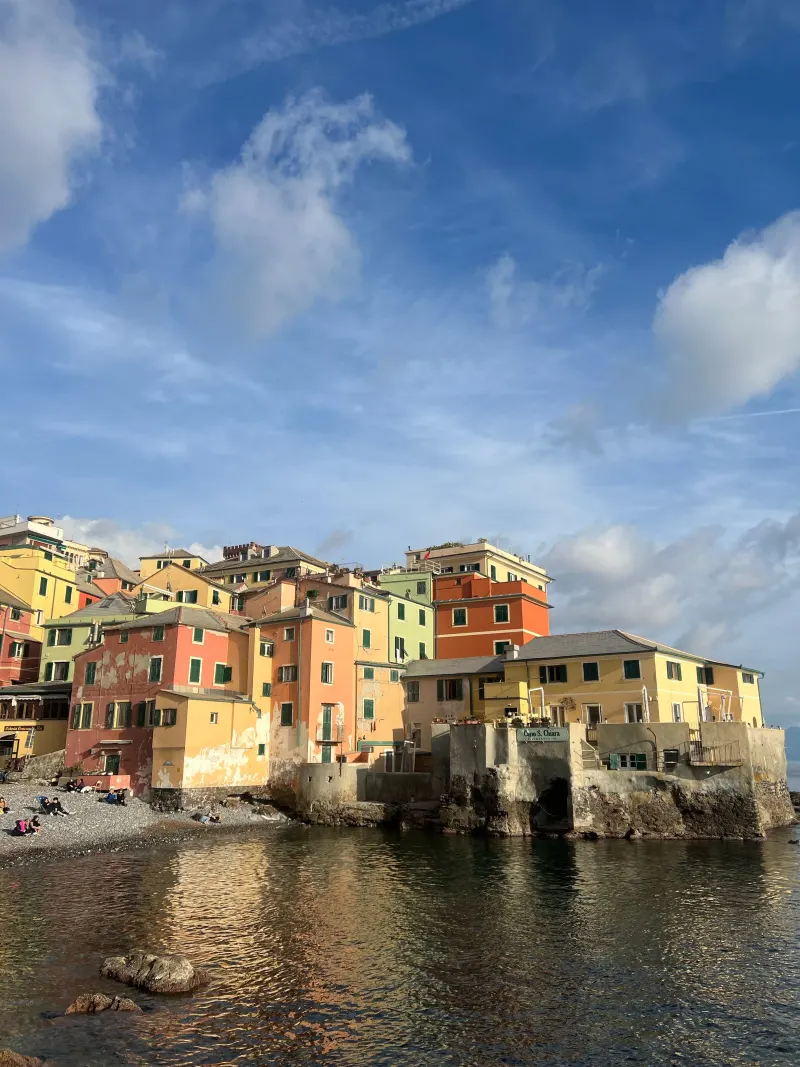
The first time you see it, you might not believe it's real. You step off a city bus, walk a few minutes down a wide avenue, and then the urban noise dissolves. In front of you: a horseshoe-shaped cove, dark pebbles lapped by clear water, pastel-coloured houses stacked up the hillside — faded pink, ochre yellow, salt-bleached green — and small fishing boats pulled up on the shore. No resort infrastructure, no beach umbrellas for rent, no souvenir shops selling plastic lemons. Just a neighbourhood that has been here for centuries and sees no reason to change.
According to local tradition, Boccadasse was founded by a group of Spanish fishermen who took shelter in this natural bay during a storm. The inlet offered protection from the open-sea winds, and the temporary refuge became a permanent settlement. For centuries the village lived off the sea — nets spread out to dry on the waterfront, boats painted in red and blue, a tight-knit community with its own rhythms, its own chapel, its own identity. Today it is one of Genoa's most beloved neighbourhoods: where locals come on Sunday mornings for coffee by the water, and where the best gelato in the city is made without fuss or fanfare.
What to See in Boccadasse
The village is compact — you can walk every alley in thirty easy minutes — but each corner rewards attention.
- Piazza Nettuno — The heart of the village, where the coloured facades reflect in the water. Come early in the morning when the light is low and the boats are still coming in, or at sunset when the plaster walls glow orange. Every angle is a photograph.
- The Church of Sant'Antonio da Padova — A seventeenth-century fishermen's chapel, small and unadorned, with an apse that almost hangs over the sea. Inside, votive offerings and model ships remember the sailors who left and didn't return. Open during services.
- Castello Türke — A Liberty-style villa perched on the promontory at the eastern edge of the bay. The building itself is private, but the path around it is open and offers views stretching all the way to Portofino on clear days.
- The free beach — A narrow strip of dark pebbles next to the Bagni Squash bathing establishment. No sun beds, no facilities, just the sea and the village facade behind you. In summer, locals swim here every day.
- Voglia di Gelato — There is almost always a queue. It is worth it. The dark chocolate and the lemon are the two classics; the seasonal fruit flavours are consistently excellent.
The Sophia Loren Connection
Just a short walk from Boccadasse, along the Corso Italia promenade, stood the Nuovo Lido bathing establishment — one of the most glamorous spots in 1950s Genoa, with its open-air pool, wooden changing cabins, and weekend orchestras. It was also the site of regional selections for the Miss Italia contest.
In 1950, a sixteen-year-old girl from Naples participated in the selections here. Her name was Sofia Scicolone. She was chosen, went on to the national competition, and from that point the trajectory of her life changed irrevocably. The world would come to know her as Sophia Loren. The Nuovo Lido is long gone — replaced by a residential building — but the story survives, told with quiet pride by Genoese as a small, delightful footnote to cinema history.
How to Get to Boccadasse from Genoa City Centre
Boccadasse sits at the eastern end of Corso Italia, Genoa's main seafront promenade. Getting there from the historic centre or from Genova Brignole station (the main rail hub for eastern Liguria) is straightforward.
- By bus from Piazza De Ferrari or Brignole station — Take AMT line Italia 6 / Boccadasse. The bus runs frequently and the final stop is the village entrance. A standard AMT ticket (valid 100 minutes) covers the journey. Journey time from Brignole: around 20 minutes.
- On foot from Brignole station — Walk south to the seafront (about 10 minutes), then follow Corso Italia east all the way to the end. The walk along the promenade takes around 40 minutes at a relaxed pace, with the sea to your right the whole way.
- By train to Genoa — Genova Brignole is the most convenient station for Boccadasse, though most high-speed trains stop only at Genova Piazza Principe (the western hub). From Piazza Principe, take any train or metro to Brignole, then follow directions above.
- By car — There is no parking in Boccadasse. Leave your car in the city centre (Piazza Verdi or Via Casaregis are the closest options) and continue by bus or on foot.
- By taxi or rideshare — Taxis reach the village entrance directly. Ask to be dropped at Via Boccadasse.
When to Visit
Boccadasse is at its most atmospheric on a weekday morning, when the tourist numbers are low and the light is soft. On summer weekends the village fills quickly — it is popular with Genoese families, and the small square can get crowded by midday. That said, even in high season there is something worth staying for: late afternoons bring aperitivo hour, teenagers jumping from the rocks, families sitting on the harbour steps as the sun drops behind the hills. A different kind of beautiful.
The village has no opening hours — it is a lived-in neighbourhood, always accessible. October and November, when the summer visitors have left but the weather is still mild, are perhaps the best months of all: the sea is calm, the light is golden, and Boccadasse is briefly, entirely yours.
Stay on the Ligurian Riviera with CasaViva
Planning your trip? CasaViva offers hand-picked apartments in Camogli, Rapallo, Santa Margherita Ligure and Genoa. Book directly — best rates guaranteed, no commission fees.
Browse available apartments →