
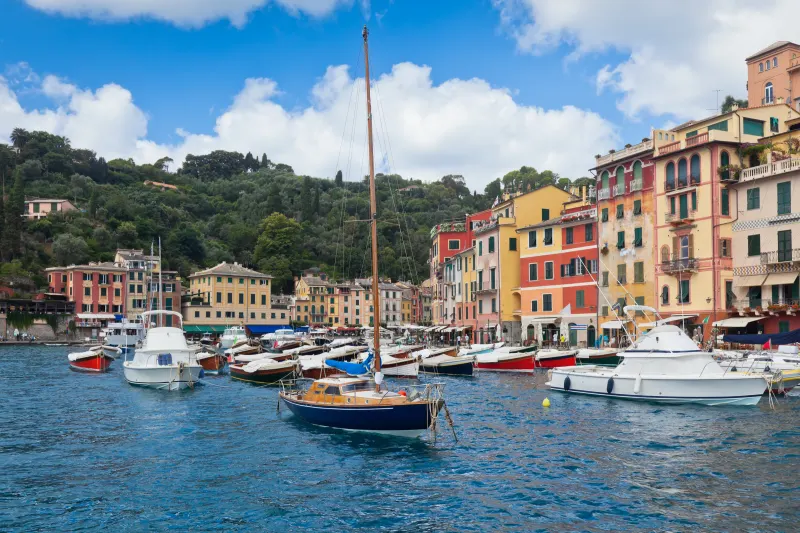
Portofino is one of those places that somehow manages to exceed expectations and disappoint at the same time — depending entirely on how you approach it. Arrive on a crowded August afternoon, circle the harbour looking for a place to sit that doesn't cost twenty euros, and you'll wonder what all the fuss was about. Arrive on an October morning by boat from Camogli, with the sea glassy and the piazzetta still in shadow, and you'll understand immediately why this small village of 400 people has been painted, photographed and written about for over a century.
Portofino is not a resort. It has no sandy beach, no nightlife, no convenience stores. What it has is a harbour of almost absurd beauty, pastel-coloured houses climbing the rock above the water, a medieval castle with a garden suspended over the Mediterranean, and coastal paths that cut through pine and rosemary and juniper down to the sea. It is the kind of place that exists more beautifully in memory than in the moment — which is reason enough to give it the right moment.
The best practical decision you can make is not to stay there. From Camogli or Santa Margherita Ligure — both under 25 minutes by boat — you can arrive early, see everything without rushing, and leave before the midday crowds arrive. That is how Portofino is done properly.
What to See in Portofino
Castello Brown is the first stop and the best view. A 15-minute walk from the harbour along a stone path through olive trees brings you to a castle that passed through various hands before being bought in the nineteenth century by British consul Montague Yeats Brown — whose name it still carries. Today it houses a small museum and, more importantly, a panoramic garden with views over the entire gulf. Entrance is around €5. Worth every cent.
Oratorio di Santa Maria Assunta is a fourteenth-century Gothic oratory tucked into the lanes behind the piazzetta. Inside, a Crucifixion attributed to Van Dyck and a stillness that seems impossible given what is happening outside. Opening hours are limited; arriving early in the morning gives you the best chance of finding it open.
The Lighthouse at Punta del Capo is the reward at the end of the best walk in the village. From the harbour, a coastal path winds through Mediterranean scrub — lentisks, cork oaks, wild herbs — for about 30 to 40 minutes until it reaches the white lighthouse that has guided ships since 1870. The view from here takes in the full sweep of the Gulf of Tigullio. Wear proper shoes and bring water in summer.
The Piazzetta and Via Roma are the social heart of Portofino. The square is ringed by houses in ochre, dusty rose and lemon yellow, with dark green shutters and wrought-iron balconies. It is worth sitting here for half an hour simply to watch — though coffee and aperitifs at the harbour-front cafes cost two or three times the Ligurian average. Consider it a scenic surcharge.
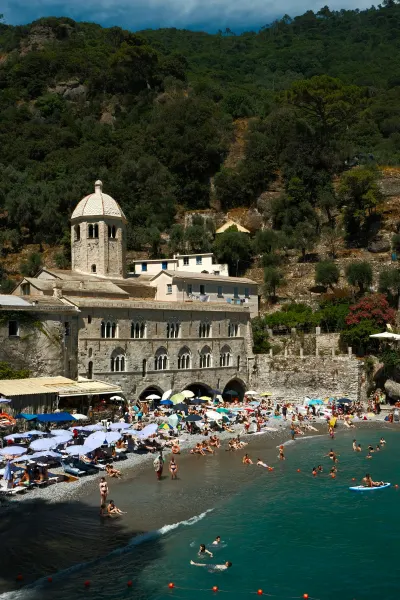
Church of San Giorgio stands on a rocky spur above the harbour, its white facade visible from the sea. Legend holds that crusaders brought the relics of Saint George here. The interior is spare and quiet; the terrace in front offers one of the best views down onto the harbour below.
When to Visit Portofino (Avoiding the Crowds)
July and August are the months to avoid entirely. The village becomes genuinely overcrowded, parking is blocked kilometres away, and prices in the restaurants spike aggressively. Portofino in peak summer is an experience most visitors prefer not to repeat.
September and October are the best months. The sea stays warm into late September (around 24°C), the light turns golden and low, day-trippers thin out considerably and the village recovers something of its actual character. October in particular is exceptional: the macchia colours, the air is crisp in the mornings, the afternoons are long and clear.
Early morning visits work even in summer. The first boat from Santa Margherita arrives before 9am, and for an hour or two the piazzetta is almost empty. Photographers know this: the soft morning light on the coloured facades is the shot everyone is trying to get, and it is only available before the crowds arrive.
April and May are another excellent window — wildflowers on the headland, quiet harbour, restaurants that have not yet switched to high-season pricing.
How to Get to Portofino — All Your Options
Portofino has no railway station. Getting there is part of the experience, and some options are considerably more pleasant than others.
By boat from Santa Margherita Ligure — the best option, full stop. The crossing takes about 10 minutes, boats run every 30 to 60 minutes from April through October, and the fare is around €7–9 each way. You leave from Santa Margherita's port, round the headland, and arrive directly at the piazzetta. The view on the approach — the harbour opening up between the cliffs — is worth the ticket price on its own.
By boat from Camogli — a longer crossing (20–25 minutes) but equally scenic. The Battellieri del Golfo Paradiso runs regular services. If you are staying in Camogli, there is no need to take the train to Santa Margherita first: just board the boat directly from the town harbour.
On foot from Santa Margherita Ligure — the coastal path connecting the two towns is one of the most beautiful short walks on the Italian Riviera. About 5 kilometres, a moderate elevation change, and 90 minutes at a comfortable pace. The trail passes private villa gardens, hidden coves, pine forests and several viewpoints that rival anything in Portofino itself. Wear walking shoes — not beach sandals — and carry water. The walk back can be done by boat.
By bus from Santa Margherita — the ATP line is the cheapest option (around €2) but comes with an important caveat: the bus terminates at Portofino Mare, the parking area above the village, not at the piazzetta itself. From there it is a 10–15 minute walk downhill on a paved road. Useful as a return option; less pleasant as an arrival.
By car — genuinely not recommended. Parking spaces in and around Portofino are extremely limited, expensive (up to €8–10 per hour in season) and often full by 9am. The coastal road jams badly on summer weekends. Leave any car in Santa Margherita and take the boat.
Getting here from Genoa Airport (Cristoforo Colombo) — for first-time visitors flying into Liguria, the journey is straightforward. From the airport, take the Volabus shuttle or a taxi to Genoa Brignole or Genova Piazza Principe station (20–30 minutes). From there, regional trains run frequently along the coast to Santa Margherita Ligure–Portofino station — the journey takes about 35–45 minutes and costs under €5. From the station in Santa Margherita it is a short walk to the port, where boats to Portofino depart regularly. Total travel time from the airport: around 1 hour 15 minutes, with no car required.
How Much Does Portofino Cost?
The visit itself is free. Walking the village, hiking to the lighthouse, sitting on the church terrace — none of it costs anything. Castello Brown charges a modest entrance fee (around €5). The churches are free.
The expenses come in the cafes and restaurants. A coffee at a harbour-front table runs to €4–6. An Aperol Spritz on the piazzetta: easily €15–20. A full lunch at one of the restaurants facing the port will exceed €50 per person without difficulty. This is not a complaint about quality — the food is often good — it is simply the arithmetic of a place where real estate and operating costs are among the highest in Italy.
The pragmatic approach: eat breakfast in Camogli or Santa Margherita, pack a lunch to eat on the lighthouse path, and allow yourself one drink on the piazzetta as a deliberate indulgence. That way the bill is manageable and the experience remains the point.
Where to Stay Near Portofino
Hotels in Portofino are few, exclusive and extremely expensive. But you do not need to stay there — the surrounding towns are better bases in almost every practical sense.
Santa Margherita Ligure is the closest base and the most convenient. It has an active fishing port, a good selection of restaurants, a pleasant seafront promenade and enough daily-life infrastructure (markets, pharmacies, coffee bars) to feel like a real town rather than a tourist set piece. The boat to Portofino leaves every hour. Rental apartments here are significantly cheaper than Portofino hotels, with the same strategic position.
Camogli is for those who want the most authentic Ligurian experience available. Impossibly tall painted houses above a pebble beach, a fish market that still functions as fish markets should, narrow streets with washing strung between the buildings. It sits slightly further from Portofino (20–25 minutes by boat) but many visitors who come for Portofino end up falling for Camogli instead — and returning for it.
Either town gives you the same access to Portofino at a fraction of the cost, plus the experience of living in a place that Ligurians actually inhabit.
Stay on the Ligurian Riviera with CasaViva
Planning your trip? CasaViva offers hand-picked apartments in Camogli, Rapallo, Santa Margherita Ligure and Genoa. Book directly — best rates guaranteed, no commission fees.
Browse available apartments →