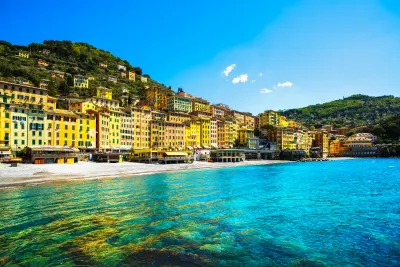

There is a specific moment when Camogli gets you. Usually it happens on the first morning: you walk down to the harbour, still half asleep, and you find yourself standing in front of something you cannot quite categorise. It is not a postcard — it is too real for that. Fishing boats are already coming in, a man is sorting nets on the dock, someone is drinking an espresso standing at the bar. Then you look up and see the houses: impossibly tall and narrow, painted in shades of ochre and burnt sienna and faded yellow, their reflections trembling in the green water below. And you understand that you have arrived somewhere that exists for its own reasons — not for tourists, but in spite of them.
Camogli is not famous like Portofino. It has no superyachts in the harbour, no celebrity-watching piazza. It is not as large as Rapallo. It is something different, and in many ways something better: a genuine fishing village that has held on to its identity, its traditions and its community, while sitting at the gateway to one of the most spectacular stretches of coastline in the Mediterranean.
1. A Harbour That Looks Like a Painting — and Has the History to Match
The houses of Camogli are tall. Extraordinarily tall. Four, five, six storeys, pressed together along the waterfront, so narrow that in the back alleys you can almost touch both walls at once. This was not an accident of urban planning: the buildings were constructed this way so that fishermen's wives could climb to the upper floors and watch for their husbands' boats returning from the sea. In the eighteenth century, Camogli was one of the most important maritime centres in the Mediterranean — a fleet that rivalled those of much larger cities, all managed from this small village clinging to the rock.
Today those houses are painted in pastels that time has made perfect: faded just enough to look authentic, vivid enough to glow pink and orange when the sun drops toward the water. Sit at a table on the lungomare around seven in the evening and watch the reflections move on the surface of the harbour. You will not need to do anything else.
2. The Sea of the Portofino Marine Park — Reachable Only From Here
Camogli sits at the entrance to the Portofino Natural Regional Park and, crucially, to one of Italy's most important Marine Protected Areas. The waters here are remarkably clear, the seabeds rich with posidonia meadows and marine life that has had decades to recover. But what most visitors do not realise is that the most extraordinary places along this coast are accessible only by sea — and the natural departure point is the port of Camogli.
San Fruttuoso is the name to remember: a medieval abbey that rises directly from a small beach, tucked into a cove reachable only by boat or after two hours of hiking through pine forest. Beneath the surface, at sixteen metres depth, stands the Cristo degli Abissi — a bronze statue placed on the seabed in 1954, visited each year by divers from around the world. Take the ferry from Camogli on a calm morning, sit on the bow, and watch the headland of Portofino slide past. It is the kind of experience that stays with you.
3. Ligurian Cooking at Its Most Honest
Three kilometres from Camogli sits Recco — and for anyone serious about Italian food, that name means one thing: the original focaccia col formaggio, made with pastry-thin dough and molten crescenza cheese, baked in a wood-fired oven and eaten burning hot, torn apart with your hands. Not a supermarket version. The real thing. Camogli and Recco together form a culinary axis worth travelling for on its own.
Back at the harbour, the restaurants change their handwritten menus daily based on what came in that morning. Trofie al pesto — made with fresh basil from the Prà valley, pounded in a mortar, not spooned from a jar. Marinated anchovies in local olive oil. Sea bass baked with potatoes and Taggiasca olives. Ligurian cuisine is a poor man's cooking that, treated with respect and made with good ingredients, becomes extraordinary. In Camogli, that tradition is still alive.
4. The Sagra del Pesce — a Collective Ritual Since 1952
Every second weekend of May, Camogli does something remarkable. The Sagra del Pesce — the Fish Festival — fills the lungomare with the smell of frying oil and the sound of the whole village gathered together. A giant pan, reportedly the largest in the world at three metres across, is set up on the waterfront and used to fry hundreds of kilos of fresh fish, which is then distributed free to everyone present.
This is not a tourist event dressed up as tradition. It has been running since 1952, organised by the local Pro Loco, and it is the kind of gathering where local families queue alongside visitors from across Europe, where elderly residents sit in plastic chairs watching the sea, and where the whole thing feels entirely, stubbornly real. If you can time your visit for that weekend, do not hesitate.
5. The Perfect Base for Exploring the Gulf — Without a Car
There is a practical reason to choose Camogli as your base, alongside all the aesthetic and culinary ones. The train station is a five-minute walk from the harbour. From there: Santa Margherita Ligure in ten minutes, Rapallo in fifteen, Genoa in thirty. The entire Ligurian Riviera unfolds without ever needing a parking space or a navigation app.
From the port, ferries run to Portofino in twenty minutes, San Fruttuoso in thirty, and the Cinque Terre in just over an hour. You can leave the car at home — or not bring one at all — and move the way people moved here seventy years ago: by train and by boat, always watching the sea from the right side.
Camogli does not ask much of you. It asks you to walk down to the harbour early, buy warm focaccia from the bakery in the caruggio, sit on the rocks and watch the light change on the water. It is a holiday that works at exactly that pace: slow, unhurried, and entirely real. Which is why, once you have been, you find yourself thinking about going back.
Stay on the Ligurian Riviera with CasaViva
Planning your trip? CasaViva offers hand-picked apartments in Camogli, Rapallo, Santa Margherita Ligure and Genoa. Book directly — best rates guaranteed, no commission fees.
Browse available apartments →