
There are places in Italy where the landscape genuinely surprises you — even after a thousand photographs. The Gulf of Tigullio is one of them. Pastel-colored houses tumbling down to the sea, fishing harbors that look hand-painted, the scent of salt air and focaccia drifting through narrow lanes. Three days here, with Camogli as your base, is enough to fall completely in love with this stretch of the Italian Riviera.
Why Camogli and not Santa Margherita or Portofino? Because Camogli is the real thing — a working fishing village that hasn't been entirely swallowed by tourism, with honest restaurants, affordable accommodation, and a character that the more famous neighbors have partly lost. And everything else is within easy reach.
Getting There: From Milan or Genoa Airport
Camogli is well-connected by rail. From Milan Centrale, take a regional Intercity or high-speed train to Genoa (about 1h 30 min), then change for the local Trenitalia service toward La Spezia — Camogli station is roughly 25 minutes from Genoa Brignole. Total journey from Milan: around 2 hours.
From Genoa Cristoforo Colombo Airport, take the Volabus shuttle to Genoa Brignole station, then the local train to Camogli. Budget about 1 hour total. Taxis from the airport are significantly more expensive and rarely worth it given how good the rail connection is.
Day 1 — Camogli: the Village That Stays With You
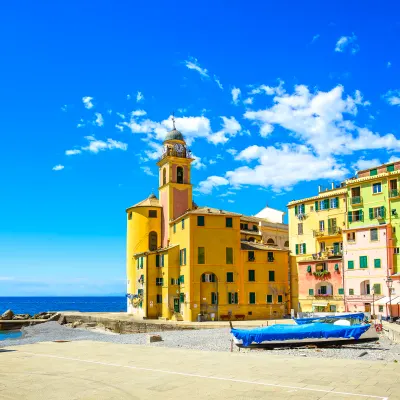
Arriving at Camogli by train is an experience in itself. The station is tiny and sits directly on the seafront — step off the platform and you're already looking at the harbor, the stacked houses painted in deep reds and warm yellows, the fishing boats bobbing in the water. No taxi transfer, no urban sprawl to navigate. You're immediately inside the place.
Start your morning at the fishing harbor, one of the most active on the Ligurian coast. The boats come in early, and the atmosphere around the docks at 8am is a world away from tourist Italy. Then climb to the Castello della Dragonara, perched on a rocky promontory above the sea. Even when the interior isn't open, the views from the surrounding terrace are exceptional: the Gulf stretching south toward Portofino, the water shifting from deep blue to turquoise as it nears the shore.
Lunch means one thing: focaccia col formaggio. Camogli sits just a few kilometers from Recco, the town where this paper-thin cheese-filled flatbread was invented and perfected. Find a bakery that pulls it fresh from the oven — the crescenza cheese should ooze, the pastry should crackle at the edges. Pair it with a glass of Vermentino and eat standing up, the way the locals do.
The afternoon belongs to the beach — a long arc of dark pebbles beneath the tall houses. It's not a manicured resort beach, but that's the point. By late afternoon, when the light turns amber and the fishing families start gathering at the waterfront bars, Camogli becomes something close to perfect. Settle in with an Aperol Spritz and watch the sea change color.
Day 2 — Santa Margherita Ligure: Art Déco Elegance on the Gulf
The train from Camogli to Santa Margherita Ligure takes about 10 minutes. Alternatively, in summer, the local ferry service connects the two harbors — pricier than the train but the coastal approach is spectacular and worth doing at least once.
Santa Margherita has a different energy from Camogli — more polished, more international, with a Liberty-era elegance that shows in the grand hotels and ornate façades along Lungomare Marconi. The promenade lined with palms and moored sailing boats is one of the most pleasant walking routes on the entire Riviera.
The main cultural stop is Villa Durazzo, a 17th-century noble residence surrounded by formal Italian gardens with sea views. The gardens are open to the public and deserve at least an hour: fountains, statues, wisteria-draped pergolas, and an atmosphere of unhurried beauty that makes you forget the harbor crowds below. The villa also hosts temporary contemporary art exhibitions throughout the season.
Take time for the church of Santi Gervasio e Protasio in the town center — its ornate Baroque façade is one of Santa Margherita's defining images, and the richly decorated interior provides a cool, quiet pause.
Lunch on the harbor: most restaurants along the waterfront are reliable. If you see muscoli ripieni on the menu (stuffed mussels, a Ligurian tradition), order them. They're a dish of the cucina povera tradition — mussels filled with breadcrumbs, herbs, and Parmigiano, then baked — and in Santa Margherita they still make them properly.
The afternoon can go two ways: wander the shopping streets of the centro storico (there are good delis and artisan shops tucked among the boutiques), or tackle the coastal footpath toward Portofino. The trail takes about 90 minutes and hugs the cliff through Mediterranean scrubland, with views that keep getting better around every corner. If you do this today, you can take the boat back from Portofino rather than walking both ways.
Day 3 — Portofino: the Icon, in a Day
Portofino doesn't need more than a day — and that's not a criticism. It's a small promontory village, extraordinarily beautiful, that rewards a focused visit rather than an extended stay. The best way to arrive is by ferry from Rapallo or Santa Margherita Ligure; boats run regularly from April through October, and landing directly at the piazzetta is the kind of arrival that photographs themselves into your memory permanently.
The piazzetta is exactly what you've seen in pictures — pastel facades, superyachts, café tables crowding the harborfront. Sit down for a coffee. Yes, you're paying for the postcode. It's worth it once.
From the village, climb to Castello Brown, the 16th-century fortress overlooking the entire bay. The views from the battlements take in the promontory, the lighthouse at the tip, and on clear days the horizon where the Ligurian Sea merges into the open Mediterranean. The path up through olive trees and hidden garden walls is part of the pleasure.
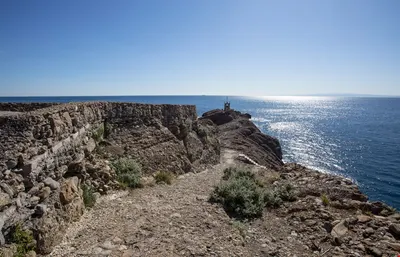
Allow time to walk down to the lighthouse at Punta del Capo — the very tip of the promontory, with open sea on three sides and a silence that's startling after the busy piazzetta. This is the version of Portofino that most day-trippers miss.
End with an aperitivo in the harbor before catching the last ferry back. Portofino at golden hour, when the tourist rush eases and the light goes warm and low, is the image you'll carry home.
Getting Around: Trains, Boats and Footpaths
The regional train (Trenitalia, La Spezia direction) is the backbone of your trip. Camogli, Santa Margherita-Portofino, and Rapallo all have central stations with frequent service. Tickets are cheap and no reservation is needed — validate before boarding.
Seasonal ferries connect the harbor towns from April to October. The Camogli–Santa Margherita–Rapallo–Portofino route runs multiple times daily and is one of the best values on the Riviera. Check Golfo Paradiso and Servizio Marittimo del Tigullio for schedules.
The coastal footpath between Santa Margherita and Portofino (about 7 km, 90 minutes) is the most scenic walking route on the gulf and manageable for anyone reasonably fit. Wear proper shoes, bring water, and start early in summer — it's exposed and hot by midday.
When to Go: September and October Are Ideal
Avoid August if you can. The Gulf of Tigullio in high summer is genuinely overcrowded, prices are at their peak, and Portofino in particular becomes difficult to enjoy under the weight of the crowds. Heat and humidity add to the challenge.
September is the sweet spot: the sea is still warm enough to swim (25–26°C), the light is golden and low, the summer crowds have thinned, and restaurant prices drop noticeably. You can book accommodation with a few days' notice rather than months in advance.
October offers something different — a quieter, more local version of the Riviera. The villages return to their own rhythms, the vegetation starts to shift, and the clear autumn days produce a quality of light that makes every photograph look effortless.
May and June are also excellent: spring on the Ligurian coast is lush and fragrant, the wildflowers are in bloom on the hillsides, and the seafront is busy but not overwhelmed.
Stay on the Ligurian Riviera with CasaViva
Planning your trip? CasaViva offers hand-picked apartments in Camogli, Rapallo, Santa Margherita Ligure and Genoa. Book directly — best rates guaranteed, no commission fees.
Browse available apartments →