
There's a place on the Ligurian Riviera that manages something genuinely rare: it's elegant without being exclusive, lively without being chaotic, and authentic without feeling neglected. That place is Santa Margherita Ligure — and if you're planning a trip to Liguria and still haven't decided where to base yourself, your search ends here.
It's not Portofino — too expensive, too crowded with superyachts, too carefully curated around its own myth. It's not Camogli — smaller, more intimate, wonderful but with fewer services. Santa Margherita is the perfect balance point of the Gulf of Tigullio: a real town with a real harbour, a real market, restaurants where locals actually eat. And from here, Portofino is twenty minutes away by boat.
Getting to Santa Margherita Ligure
Santa Margherita Ligure is easy to reach by train — and that's one of its great advantages. From Milan, the journey takes around 2 hours (direct Intercity trains from Milano Centrale or change at Genoa). From Genoa Brignole station, it's just 45 minutes on a regional train, with departures every 30–60 minutes. The station is a short five-minute walk from the harbour and town centre. By car from Milan, allow about 2h30 via the A7 and A12 motorways.
What to See in Santa Margherita Ligure
The first thing that strikes you arriving from the station is the Lungomare Marconi — the seafront promenade. This is no ordinary coastal walkway: Liberty and art déco villas in pastel shades of ochre yellow, sage green and dusty rose line the seafront, built in the early twentieth century when Santa Margherita was already a destination for European high society. Walk it slowly, preferably early in the morning when the light is softer and the colours more vivid.
Above the town centre, Villa Durazzo and its gardens are open to the public and often overlooked by tourists in a hurry. The seventeenth-century villa hosts temporary exhibitions, but it's the Italian-style park — with panoramic terraces, heritage roses and centuries-old cedar trees — that makes the uphill walk worthwhile. The gardens are free to enter, and the view over the gulf from the upper terrace is outstanding.
In Piazza Caprera, the Basilica of Santa Margherita d'Antiochia is a stunning example of Ligurian Baroque. The plain white facade gives no hint of what lies inside: polychrome marble, gilded stucco and paintings from the Genoese school covering every surface. Worth a visit even for those who don't usually seek out churches.
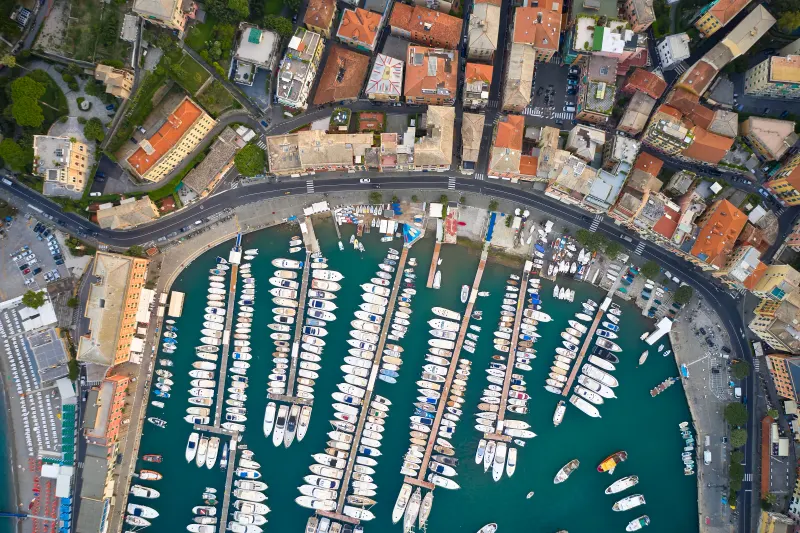
The tourist harbour is the beating heart of the town — fishing boats moored alongside sailing yachts, the ferry ticket kiosk for boat trips, waterfront bars with outdoor tables. This is where boats depart for Portofino and San Fruttuoso, and where you want to be for an aperitivo at sunset.
If you're visiting on a Wednesday morning, don't miss the weekly market in Piazza Mazzini: local fruit and vegetables, aromatic herbs, cheeses from the Valle Fontanabuona. Unlike many Italian market towns where the weekly market has become a tourist affair, this one still genuinely serves the community.
What to Do in Santa Margherita Ligure
The most obvious — and most justified — excursion is taking the boat to Portofino. Ten minutes from the harbour, ferries run frequently from April to October, and the fare is reasonable. Portofino seen from the water, with its coloured houses reflected in the tiny harbour, is one of those views that never disappoints. Once there, the walk up to the Punta del Capo lighthouse or the church of San Giorgio is worth every uphill step.
For walkers, the coastal path to Portofino is arguably the finest trail on the Eastern Riviera. Five kilometres, about one and a half hours, with continuous views over the sea and the promontory. The route passes through Paraggi — one of the few public beaches on this stretch — before descending into Portofino. Comfortable shoes and a reasonable level of fitness are all you need.
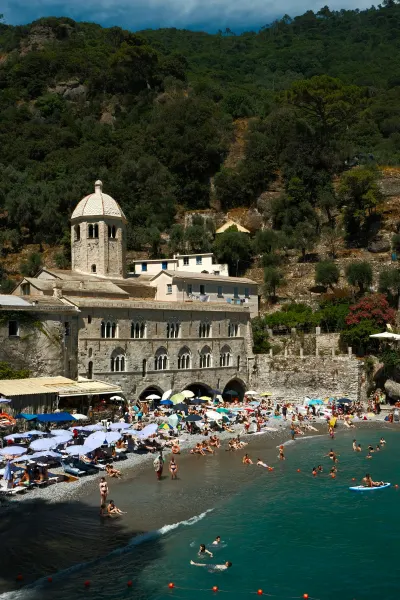
The trip to San Fruttuoso is for those who want something truly extraordinary: a medieval Benedictine abbey reachable only by boat or on foot, tucked between cliffs and sea in a cove that looks painted. Forty-five minutes by boat from Santa Margherita. Under the water, 17 metres down, lies the famous Cristo degli Abissi — a bronze statue that has watched over the seabed since 1954.
From the harbour you can also rent a kayak and explore the coast at your own pace: the rocky coves between Santa Margherita and Portofino are among the most beautiful in Liguria, and experiencing them from the water on your own terms is a completely different experience from the ferry.
Beaches at Santa Margherita Ligure
To set expectations correctly: Santa Margherita is not a long sandy-beach destination. The beaches are narrow and partly pebbly, and they fill up in July and August. Private beach clubs along the seafront and towards Paraggi offer sun loungers and umbrellas (booking recommended in high season), showers and bars. Free public beaches can be found in the small coves between Santa Margherita and San Michele di Pagana. The beach at Paraggi, halfway to Portofino, is spectacular — turquoise water, shallow sea floor — but is partly private and always busy in summer.
Where to Eat in Santa Margherita Ligure
The golden rule: step away from the seafront. The restaurants facing the harbour have unbeatable views and prices to match. In the lanes of the old town you'll find the trattorias where locals eat: handmade pesto, trofie al pesto, Genoese focaccia, mixed fried fish. Look for places without an English menu displayed outside — almost always a good sign.
For a quick and authentic lunch, the town's rosticcerie sell farinata (Ligurian chickpea flatbread), plain focaccia and savoury vegetable pies — what locals actually eat for lunch. Excellent value, quality usually very high.
Santa Margherita as a Base for Exploring the Gulf
This is perhaps the most underrated advantage of choosing Santa Margherita. The railway station is five minutes from the centre, and from there:
- Rapallo: 5 minutes by train. Seaside castle, lively promenade, the Montallegro sanctuary reachable by cable car.
- Camogli: 10 minutes by train. The quintessential Ligurian fishing village, with tall painted houses rising straight from the sea.
- Genoa: 45 minutes by train. The medieval caruggi alleyways, the old port, the Aquarium — a full day isn't enough.
- Cinque Terre: reachable by train with a change at La Spezia, about 1h30–2h in total.
By boat from the harbour, Portofino is 10 minutes away and San Fruttuoso 45. It's hard to find a better starting point for exploring the Eastern Riviera while still having a well-served, genuinely pleasant town to come back to each evening.
Stay on the Ligurian Riviera with CasaViva
Planning your trip? CasaViva offers hand-picked apartments in Camogli, Rapallo, Santa Margherita Ligure and Genoa. Book directly — best rates guaranteed, no commission fees.
Browse available apartments →